


This post was originally published on this site.
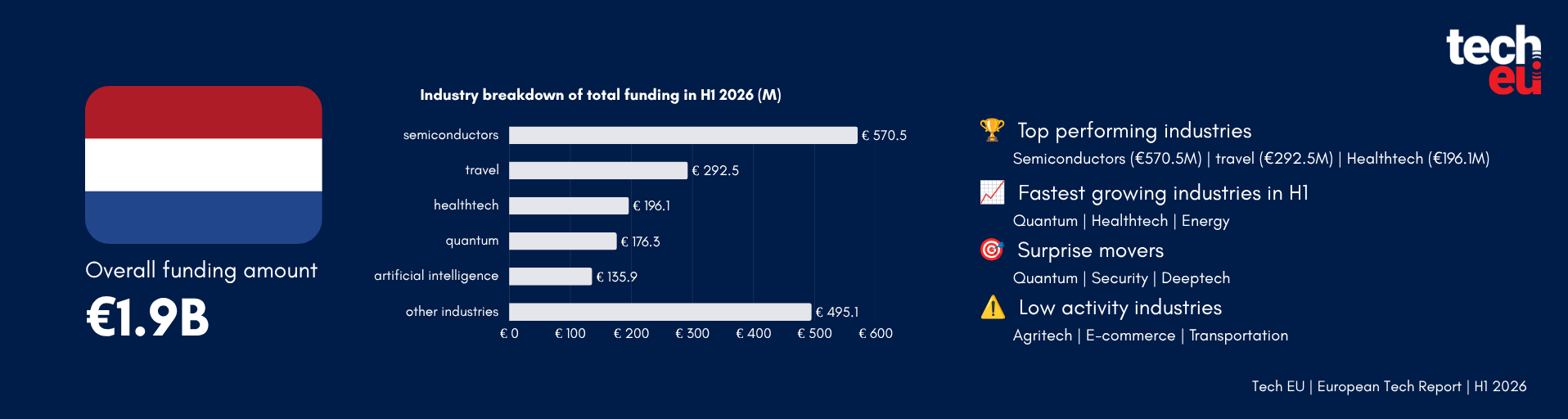
Dutch tech companies raised approximately €1.9 billion in H1 2026, with funding concentrated among the largest deals. The three largest
rounds alone accounted for approximately 44 per cent of the total, while six
companies raised more than €100 million during the period.
Semiconductors attracted the most funding, with
approximately €570.5 million, followed by travel with €292.5 million, although
funding in the latter was concentrated in two deals.
Healthtech recorded the highest level of activity by deal
count, while quantum and energy were also among the more active sectors by
total funding raised. The remaining capital was distributed across fintech,
software, deeptech, security, cleantech and a range of smaller sectors,
indicating relatively broad sector activity despite the concentration of
capital in several industries.
Later-stage rounds accounted for a significant share of
total funding, while earlier-stage activity was more fragmented and spread
across smaller deals.
Overall, H1 2026 funding in the Netherlands combined a small
number of large later-stage rounds with a broader base of smaller investments.
Semiconductors accounted for the largest share of capital, while healthtech
stood out for the number of deals and quantum also attracted substantial
funding.
For further insights into funding trends across the European
technology ecosystem, check out Tech.eu’s Funding Explorer, free and open to
everyone.
Here are the ten companies that raised the most in H1 2026.

Amount raised in H1 2026: $380M
Nearfield Instruments develops high-throughput metrology and inspection technology for the semiconductor industry.
Its systems use atomic force microscopy to provide high-resolution 3D measurements, helping chipmakers inspect and control increasingly complex manufacturing processes.
In H1 2026, Nearfield Instruments raised $380 million to fund innovation, increase production capacity and deepen collaborative R&D with semiconductor manufacturers.

Amount raised in H1 2026: $300M
Mews develops a cloud-native operating system for the hospitality industry, bringing property management, revenue management, payments, point-of-sale, housekeeping and guest-facing tools into one platform.
Its technology is used by more than 15,000 properties worldwide and is designed to automate hotel operations while supporting guest personalisation and revenue management.
In H1 2026, Mews raised $300 million to scale its AI-driven platform, expand fintech capabilities and accelerate growth across North America, Europe and new markets.

Amount raised in H1 2026: $250M
Axelera AI develops chips and software for AI inference, focusing on running AI models efficiently at the edge rather than relying solely on cloud infrastructure.
Its technology is designed to process data locally while addressing power, cooling and bandwidth constraints associated with AI deployment. The company serves customers across sectors including defence, agritech and robotics.
Axelera AI raised $250 million in H1 2026 as it continues developing and commercialising its AI inference technology.

Amount raised in H1 2026: €152M
QuantWare develops commercially available quantum processing units and produces quantum hardware at industrial scale in Europe.
Its processors are based on the company’s VIO architecture, a modular approach designed to enable larger, more energy-efficient quantum systems and allow third parties to integrate their own designs. The company is also developing KiloFab, a dedicated quantum manufacturing facility in the Netherlands.
QuantWare raised €152 million in H1 2026 to advance VIO, expand industrial production and support the build-out of KiloFab.

Amount raised in H1 2026: $150M
Wonderful develops an enterprise platform for creating, managing and optimising AI agents across customer-facing and internal workflows.
Its agents can operate through chat, voice and email, while local deployment teams support customers with implementation and integration. The company operates across sectors including telecommunications, finance, manufacturing and healthcare and has expanded to more than 30 countries.
Wonderful raised $150 million in H1 2026 to accelerate global expansion and grow its workforce.

Amount raised in H1 2026: €113.8M
RIFT develops Iron Fuel Technology for producing high-temperature industrial heat without direct CO₂ emissions.
Its system uses fine iron powder as a circular energy carrier: combustion produces heat and iron oxide, which can then be regenerated into iron fuel using hydrogen. The company targets industrial processes where electrification or hydrogen may be difficult to deploy and provides both heating systems and long-term iron fuel supply.
In H1 2026, RIFT secured €113.8 million to move towards commercial deployment and develop its first commercial iron fuel production facility.

Amount raised in H1 2026: $70M
Vitestro develops robotic technology for automated diagnostic blood collection. Its Aletta device automates the blood-drawing process and is designed for use by hospitals and laboratories.
The system has received CE marking under European medical device requirements, allowing commercial use in the EU, while Vitestro is also working with healthcare organisations on clinical deployment.
In H1 2026, Vitestro raised $70 million in Series B funding to support the development and commercialisation of its autonomous blood collection technology.

Amount raised in H1 2026: €40M
eyeo develops nanophotonic technology for image sensors, replacing conventional colour filters with structures that split and direct incoming light to individual pixels.
Its NCOS platform is designed to improve light sensitivity, colour accuracy and image resolution, with potential applications spanning consumer electronics, automotive systems, medical imaging and security. The technology is compatible with existing CMOS sensor platforms.
eyeo raised €40 million in H1 2026 to expand engineering, strengthen OEM partnerships, accelerate commercial deployment and invest in next-generation 3D-stacked CMOS image sensors.

Amount raised in H1 2026: €40M
Leyden Labs is developing nasal sprays designed to protect against respiratory viruses by delivering antibodies directly to the nasal mucosa, where airborne viruses can enter the body.
Its approach focuses on mucosal immunity and broad protection against existing and emerging viral strains. The company’s lead programme, PanFlu, is being tested in clinical trials and targets influenza.
In H1 2026, Leyden Labs raised €40 million to advance its nasal spray platform and move its programmes through clinical development towards broader access.

Amount raised in H1 2026: €37M
WorkFlex develops a software platform that automates compliance for cross-border business travel and workforce mobility.
Its technology helps organisations manage requirements related to tax, social security, immigration and labour law, including A1 certificates, posted worker notifications, visas and tax exposure assessments. Founded in the Netherlands in 2022, the company processes more than 100,000 cross-border trips annually across over 1,000 country combinations.
In H1 2026, WorkFlex raised €37 million to accelerate its European expansion, deepen product capabilities and expand into adjacent areas of mobility risk management.