

Walk through almost any appliance retailer or browse air conditioner websites long enough, and you’ll quickly notice a familiar pattern.
Many brands describe themselves as “industry leaders,” “No.1,” or “the world’s leading manufacturer.”
For consumers, those claims can be difficult to evaluate. Some refer to production volume, others measure retail sales, while still others describe a specific product category or geographic market.
Understanding what these claims actually mean can help buyers make more informed decisions—and distinguish independently verified recognition from general marketing language.
Not Every “No.1” Means the Same Thing
One of the biggest misconceptions is assuming that every leadership claim measures the same thing.
In reality, industry rankings often use different methodologies.
Some measure:
Manufacturing volume
Retail sales
Market share
Product shipments
Consumer preference
Brand awareness
Each tells a different story.
A company may manufacture the most products without holding the highest retail market share in every product category.
Likewise, a brand may lead one segment—such as inverter air conditioners—without leading every type of air conditioner sold worldwide.
Understanding the scope behind a ranking is often more valuable than the headline itself.
Independent Research Matters
Consumers naturally place greater confidence in claims supported by independent research than in statements made solely by a manufacturer.
When evaluating any leadership claim, it helps to ask several questions:
Who conducted the research?
What products were included?
What time period was measured?
What metric was used?
Is the certification still valid?
Clear answers to those questions provide useful context and may help avoid misunderstanding what a ranking actually represents. Consumers should review the underlying claim language and accompanying disclosures to understand the scope and limitations of any recognition.
Why Product Categories Matter
Another important consideration is product scope.
The air conditioning industry includes several different product categories, including:
Central HVAC systems
Split air conditioners
Window air conditioners
Room air conditioners designed for flexible placement
Performance, installation requirements, purchasing decisions, and consumer expectations vary significantly across these categories.
As a result, a leadership position in one category should not automatically be interpreted as leadership across every category.
Responsible reporting keeps those distinctions clear rather than combining unrelated markets into one simplified claim.
Manufacturing Scale Is One Measure of Industry Leadership
Manufacturing capacity is often cited as one indicator of an established global brand.
Large-scale production can also reflect supply chain reach, engineering investment, and long-term manufacturing capability.
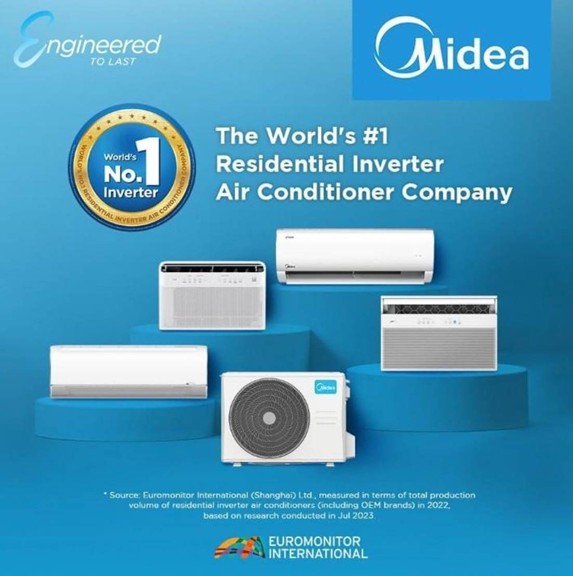
One example is Midea, whose own marketing materials reference a Euromonitor International recognition related to residential inverter air conditioners.
Importantly, this type of recognition should be interpreted in the context of its exact source, product category, measurement basis, research period, and validity period. It should not be treated as a retail-sales claim or as leadership across every room air conditioner category.
Understanding that distinction helps consumers interpret recognition accurately rather than treating every “No.1” statement as identical.
Innovation Is Another Form of Leadership
Industry leadership is not measured solely by production scale.
Consumers experience leadership through the products they use every day.
Over the past several years, room air conditioner manufacturers have increasingly focused on solving practical household challenges rather than simply increasing cooling capacity.
Examples include:
improving energy efficiency through inverter technology; designing products that better fit modern apartments; enhancing smart-home integration; improving airflow management for room-level cooling;
Reducing everyday operating noise.
Innovation becomes meaningful when it improves daily comfort rather than simply adding new specifications.
Engineering Should Support Everyday Living
Consumers rarely think about engineering in abstract terms.
Instead, they notice whether an air conditioner fits naturally into everyday life.
Can the window open and close after installation, provided it is compatible and properly set up?
Can cooling remain consistent during long summer afternoons?
Can the unit be controlled remotely before arriving home?
Does the installation fit the realities of apartment living?
These practical questions increasingly influence purchasing decisions.
For example, the Midea U-Shaped Smart Inverter Window Air Conditioner is designed, subject to window compatibility and proper installation, to enhance practical window use while incorporating inverter technology and smart-home connectivity.
Similarly, the Midea DUO combines inverter operation with a hose-in-hose airflow design intended to support efficient room-level cooling in spaces up to approximately 550 square feet on its 12,000 SACC configuration (based on manufacturer testing; actual coverage and performance may vary depending on room characteristics, installation, and operating conditions).
Rather than representing isolated product features, these examples illustrate how engineering decisions increasingly contribute to overall brand perception.
Leadership Should Be Supported by Evidence
Marketing language alone rarely helps consumers objectively compare brands.
Instead, buyers may find it useful to evaluate leadership claims using a simple framework.
Consider whether the claim includes: an independent research organization; a clearly defined product category; a transparent measurement methodology; a stated research period;
A published validity period.
The more transparent these elements are, the easier it becomes to understand what the recognition actually represents.
This approach also encourages consumers to distinguish between independently verified industry recognition and broader promotional messaging.
Looking Beyond Rankings
Industry recognition provides useful context, but it is only one part of the buying decision.
Consumers should also evaluate whether a product:
fits the intended room size; uses technology appropriate for daily use; addresses practical installation needs; supports convenient operation;
Aligns with long-term ownership expectations.
Ultimately, the value of any leadership claim depends on whether it connects to the real experience of owning and using the product.
Final Thoughts
The meaning of “industry leader” has become increasingly nuanced.
Production scale, technological innovation, product engineering, and independent recognition each describe a different aspect of leadership.
Rather than accepting broad marketing statements at face value, consumers benefit from understanding how those claims are defined and what evidence supports them.
Viewed in that context, independently verified recognition becomes more than a headline—it becomes one useful factor among many that help explain why certain brands continue to shape the evolution of the room air conditioner.
Product performance, cooling coverage, energy usage, smart-feature functionality, installation suitability, and consumer experience may vary depending on product specifications, installation, environmental conditions, and individual usage patterns. Consumers should review product specifications and claim disclosures before purchase.